
Welcome! I am the Frank H.T. Rhodes Postdoctoral Fellow at the Cornell Population Center at Cornell University. I completed my PhD in Sociology at The Ohio State University. I am an interdisciplinary sociologist of medicine, inequality, gender, and reproduction.
One strand of my research focuses on how gendered, raced, and classed inequalities manifest in embodied processes, such as pregnancy and birth. In a second strand of research, I explore how people make decisions about pregnancy and parenting across a wide variety of considerations. Underlying my body of research is an interest in how interlocking inequalities and institutions shape reproduction as a process that unfolds across the life course.
My research has been published in American Sociological Review, Social Science & Medicine, Family Relations, Perspectives on Sexual and Reproductive Health, Contraception, Journal of Primary Care & Community Health, and Reproductive Health.
Select publications are linked below and all are listed on my CV. If you have any issues with accessing a paper, or have any questions for me, please feel free to reach out at acc382@cornell.edu.
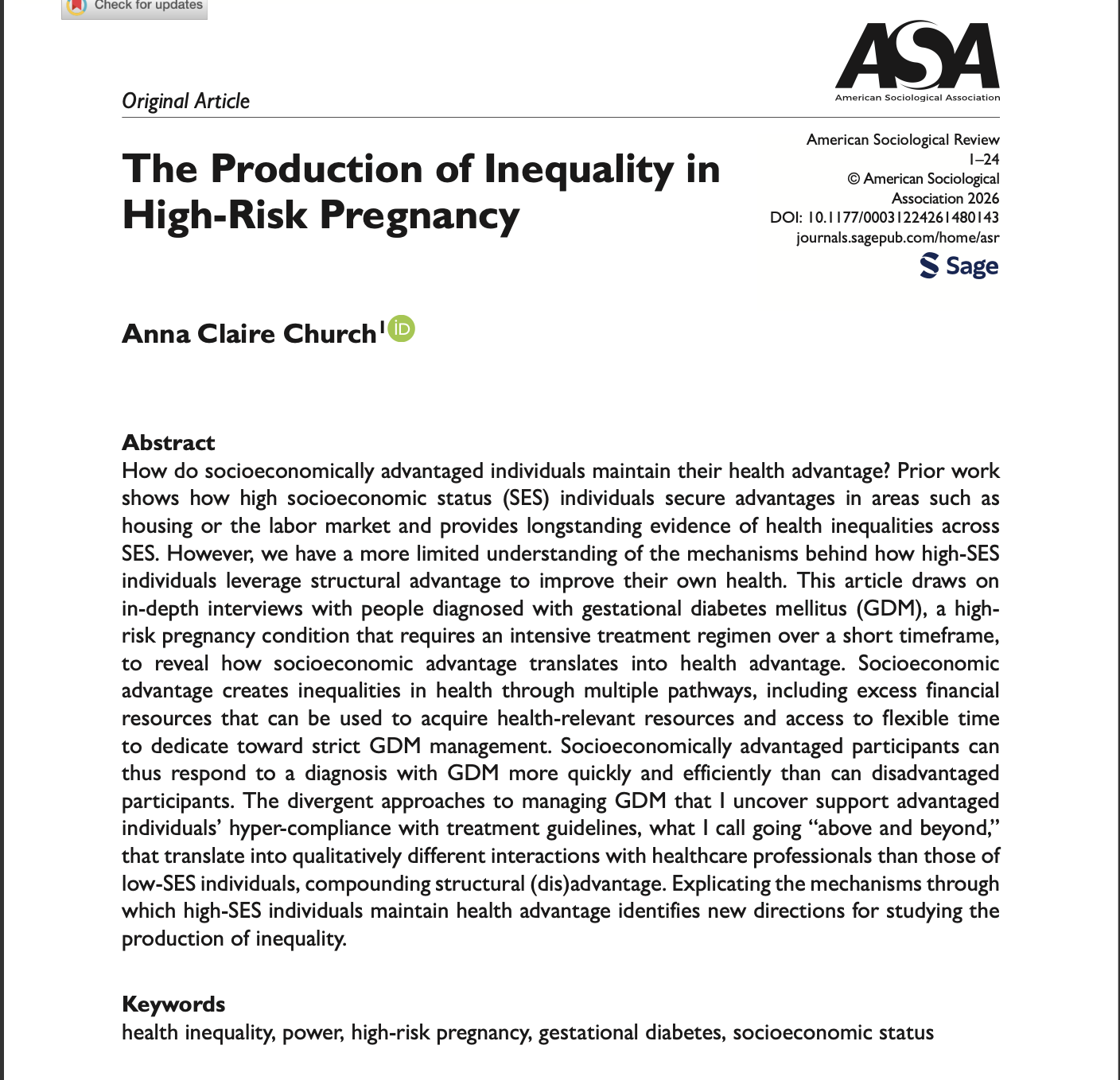
In this paper, I advance theoretical understandings of how socioeconomic advantage translates into health advantage to identify new directions for studying the production of inequality. Specifically, I identify multiple pathways through which socioeconomic advantage creates inequalities in health, such as excess and flexible financial resources and time, and how this translates into interactions with healthcare professionals.

In this paper, I (1) extend our understanding of how normalized forms of violence shape people's pregnancy and birth experiences and (2) demonstrate how obstetric violence unfolds through interpersonal interactions, the organization of labor in medicalized birth, and institutional policies and obstetric practices.

In this paper, I examine women's perceptions and experiences of solitary support from male partners during COVID-19 hospital visitor restrictions. I find that participants reported mixed feelings about birthing with a solitary support person. Marginalized women have greater concerns about birth outcomes and are more likely to feel afraid or isolated while others valued increased privacy.
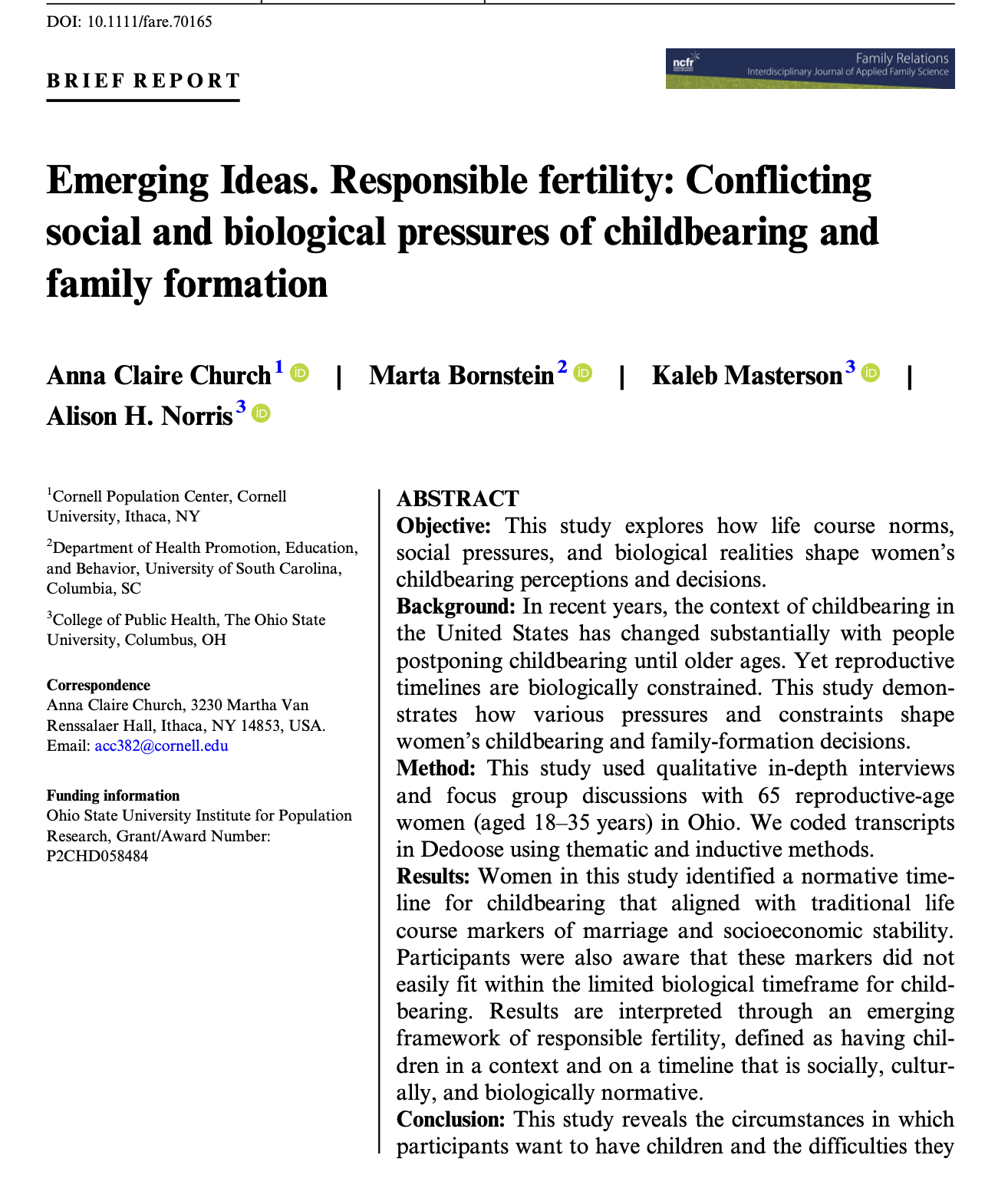
In this brief report, we develop an emerging framework of responsible fertility, defined as having children in a context and on a timeline that is socially, culturally, and biologically normative, to help explain population-level fertility change in the U.S. We reveal the circumstances in which participants want to have children and the constraints they face in doing so.
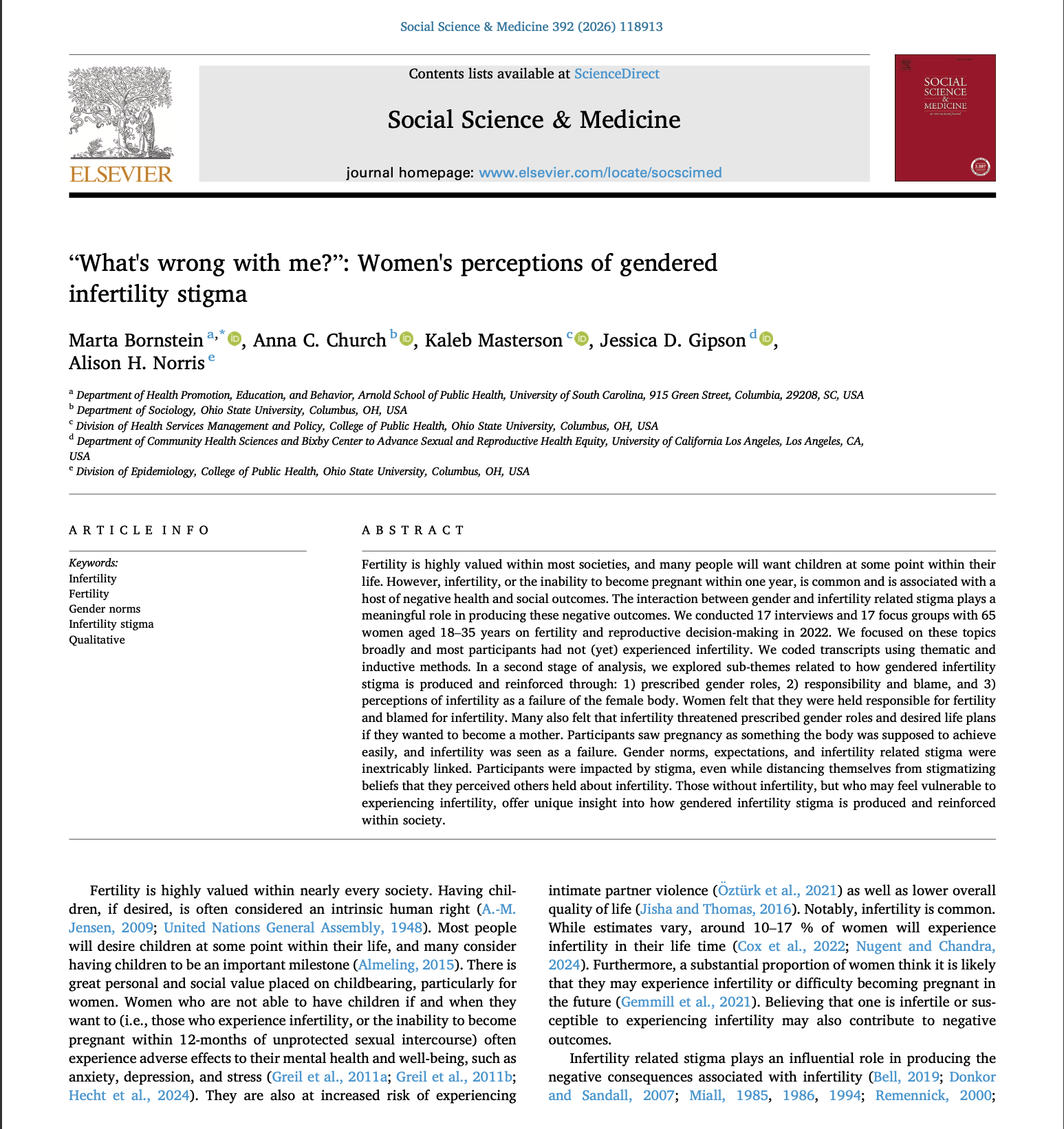
In this paper, we are interested in the interactions between gender and infertility-related stigma in producing negative health and social outcomes. We find that gendered infertility stigma is produced and reinforced through: 1) prescribed gender roles, 2) responsibility and blame, and 3) perceptions of infertility as a failure of the female body. Our participants were affected by this stigma, even when most of them had not experienced infertility.

In this paper, we use interviews and focus group discussions with reproductive-age women to explore how they perceived and experienced interactions with healthcare providers (HCPs) around their fertility. We find that participants want more information about fertility from their HCPs even if not actively trying to become pregnant, which is not well accounted for in existing pregnancy options or fertility counseling.

This scoping review synthesizes thirty years of research on the determinants of fertility desires in sub-Saharan Africa to better understand what factors underlie men and women's stated fertility desires and how they weigh the costs and benefits of having (more) children. We demonstrate how both traditionally supportive and and contemporary disruptive forces simultaneously influence fertility desires in the region.